Expressvpn Glossary
Cloud data platform
What is a cloud data platform?
A cloud data platform is a cloud-based environment for storing, processing, governing, and analyzing data from multiple sources. It helps organizations to manage large volumes of structured, semi-structured, and unstructured data without relying entirely on on-premises infrastructure.
Cloud data platforms provide shared storage, compute, and data tools for running workloads across cloud or hybrid environments. Organizations use them to connect and consolidate data from applications, devices, databases, and external services for analytics, reporting, AI, and business decision-making.
How does a cloud data platform work?
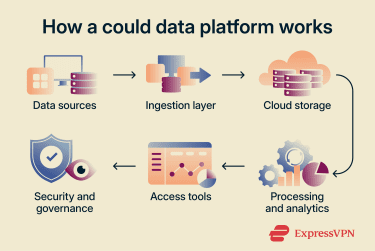
A cloud data platform typically combines several core capabilities:
- Data ingestion: Pipelines collect data from databases, applications, devices, and external services.
- Scalable storage and compute: Storage systems hold the data while cloud compute resources process and transform it.
- Unified tools and access: Processing engines, analytics tools, and APIs operate within the same platform environment.
- Governance, encryption, and monitoring: Security and governance controls regulate access, protect data, and monitor activity across the platform.
- Insight delivery: Users access processed data through dashboards, queries, reports, applications, and other data tools.
Why are cloud data platforms important?
Cloud data platforms help organizations use data more effectively across teams and systems. By integrating information from different departments and applications in a shared environment, they reduce data silos and improve collaboration.
Consolidated data supports faster decision-making by allowing analysts and applications to examine trends and operational metrics more easily.
Cloud infrastructure also allows organizations to scale storage and computing resources as data volumes grow. Many platforms also support redundancy, backups, and distributed deployment options that can help maintain availability and service continuity when configured properly.
Where are they used?
- Enterprise analytics and reporting: Organizations use cloud data platforms to aggregate operational and historical data, enabling analysts and business teams to generate reports, track performance metrics, and identify trends across departments.
- Customer data and personalization: Data from websites, mobile apps, and customer systems helps analyze behavior, segment audiences, and personalize services or marketing campaigns, subject to privacy, consent, and governance requirements.
- Machine learning and AI workloads: Cloud data platforms provide the scalable storage and compute resources needed to train machine learning models and run AI-driven analytics on large datasets.
- Security monitoring and threat detection: Security teams use centralized data platforms to analyze logs, network activity, and system events in order to detect anomalies, investigate incidents, and support threat monitoring.
- Multi-cloud and hybrid environments: Many organizations operate across multiple cloud providers and on-premises systems. Cloud data platforms can help integrate, govern, and analyze data from these distributed environments through a more consistent architecture.
Risks and privacy concerns
Cloud data platforms often store large volumes of sensitive or business-critical information, so misconfigurations, weak permissions, or poorly secured storage systems can expose that data to unauthorized users.
Organizations must also consider regulatory requirements such as data residency rules, which can restrict where certain types of information may be stored or processed.
Third-party integrations can increase the platform’s attack surface. Cloud platforms follow a shared responsibility model, meaning organizations remain responsible for securing their data, access policies, and configurations.
Organizations should also manage data throughout its lifecycle, including classification, retention, deletion, lineage, and backup copies, to avoid keeping sensitive data longer than necessary or losing track of where it exists.
Further reading
- What is a data warehouse? A complete guide
- What is big data security and privacy?
- Security concerns in cloud computing and how to address them
- What is IaaS? Infrastructure-as-a-Service explained
- Zero-trust cloud security explained